Agriculture water quality Environment Act target delivery plan
Published 1 December 2025
Applies to England

© Crown copyright 2025
This publication is licensed under the terms of the Open Government Licence v3.0 except where otherwise stated. To view this licence, visit nationalarchives.gov.uk/doc/open-government-licence/version/3 or write to the Information Policy Team, The National Archives, Kew, London TW9 4DU, or email: psi@nationalarchives.gov.uk.
Where we have identified any third party copyright information you will need to obtain permission from the copyright holders concerned.
This publication is available at https://www.gov.uk/government/publications/agriculture-water-quality-environment-act-target-delivery-plan/agriculture-water-quality-environment-act-target-delivery-plan
Statutory Environment Act target
- reduce total nitrogen, phosphorus and sediment pollution from agriculture into the water environment by at least 40% by 2038, compared to a 2018 baseline
Interim targets
-
reduce total nitrogen, phosphorus and sediment pollution from agriculture to the water environment by at least 12% by December 2030
-
reduce total nitrogen, phosphorus, and sediment pollution from agriculture to the water environment by at least 18% in catchments containing protected sites in unfavourable condition due to nutrient pollution by December 2030
Rationale for the interim targets: why and how they will progress delivery of the Environment Act target
The updated interim targets reflect a trajectory of progress towards the 2038 statutory target, with slower progress in the first 7 years and faster progress anticipated in the outer years once the additional measures taken by this government take effect.
The reduction of nutrient and sediment loads follows a pathway from the previous interim target of 10% by 2028, to at least 12% (and at least 18% in catchments containing protected sites) by 2030.
Since EIP23 there has been limited progress in implementing key measures needed to meet the statutory target, including the development of the regulatory frameworks, strengthening enforcement activity, and uptake of the Environmental Land Management schemes. Actions taken by this government, including doubling of Environment Agency funding for on farm water quality inspection and enforcement, and prioritising water actions within Environmental Land Management schemes to accelerate progress towards the statutory target, but will take time to take effect. The interim targets have been set at a realistic level to reflect the evidence for water quality improvements expected from the measures already taken.
We intend to go further and anticipate that additional measures, set out in this delivery plan but not yet fully evidenced, such as regulatory reform, will accelerate progress towards the statutory target and enable us to exceed the target of at least 12% reduction in pollution from agriculture to water (and at least 18% in catchments containing protected sites) by 2030.
Delivery measures
The pathway to the statutory and interim targets is comprised of 4 delivery pillars. Each pillar is expected to contribute towards the 40% reduction by 2038. The proportion each pillar will contribute is included in each delivery measure below.
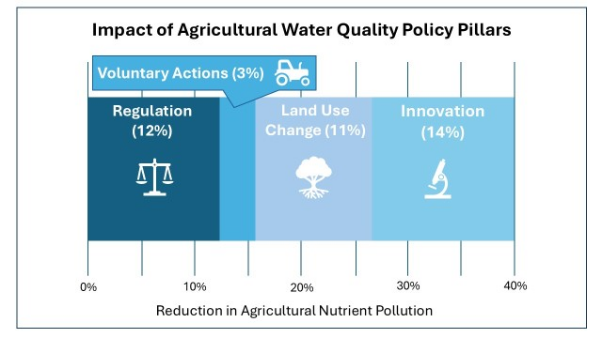
Figure 1. Policy ‘pillars’ to deliver the 2038 statutory agricultural water quality targets
Pillar 1: Regulatory compliance
Farmers must comply with rules for farming set out in the agricultural diffuse pollution regulations. We do not yet have reliable data on national compliance, but we know from the extent of compliance on inspected farms that the sector has a long way to go towards full compliance. We will continue to press for full compliance and expect that the measures set out here will lead to at least 85% compliance by 2038.
Estimated contribution to the interim target
Collectively the measures in Table 1 are estimated to make a high contribution to the interim target.
Evidence of impact
Modelling using FARMSCOPER undertaken in WT1594, a project to improve Defra’s understanding of the most effective ways to support farmers in protecting the water environment, final report (page 4), indicated that 85% compliance with regulatory mitigation measures by farmers could achieve up to 9% reduction of nitrogen loads, 14% reduction of total phosphorus loads, and 15% reduction of sediment loads.
FARMSCOPER is a tool designed to model diffuse pollutant loads on farms and assess the effectiveness of pollution mitigation measures and underpins the analysis of agriculture water targets.
The Environment Agency’s (EA’s) Agriculture Regulatory Taskforce has delivered more than 15,000 inspections on farms since 2021, prioritising those farms with the highest risk of polluting sensitive water environments. Enforcement actions are taken where necessary. We will increase inspection and enforcement funding from £5m to £12m per annum by 2029.
We are simplifying and consolidating agricultural water regulations and improving standards. Making regulations clearer and more effective is anticipated to aid compliance.
We are also developing proposals to consult on extending environmental permitting to dairy and intensive beef farms. Permitting provides a comprehensive framework to monitor and enforce compliance.
The EA farm inspection regime has demonstrated positive improvements in compliance and water quality. We will continue to focus inspections on the most at-risk farms in catchments containing protected sites.
Collaborative work between farmers and the Catchment Sensitive Farming advice service is estimated to have led to notable reductions in agricultural pollutants, with nitrogen levels falling by 4%, phosphorus by 8%, and sediment by 12% over the period 2006 to 2018, averaged across the target areas evaluated. A refreshed evaluation is currently in progress to extend this analysis and capture reductions from 2006 to 2024.
Table 1. Summary of evidence and milestones for regulatory compliance under the agricultural water delivery plan
| Delivery measure | Description | Responsible | Status |
|---|---|---|---|
| Reform Farming Water Regulations | Simplifying agri-water regulations and improving standards through a new programme of reform and co-creation with industry. | Defra grants, Environment Agency (EA) delivery, Natural England (NE) and EA advice | In development |
| Extend farm permitting schemes | Develop proposals to consult on extending environmental permitting to dairy and intensive beef farms. | Defra | In development |
| Review of the statutory guidance for the Farming Rules for Water | On 18 June 2025, the Farming Rules for Water statutory guidance was amended by the Secretary of State following an internal rapid review. The amendments provide clarity around EA enforcement of the Farming Rules for Water. Changes have clarified how the government expects the EA to enforce the Farming Rules for Water, for example around the spreading of organic manures, to help both the environment and practical farming. |
Defra, EA | In delivery |
| Advice and enforcement | We will double our funding for EA farm inspections over the 3 years to 2029 to ensure farmers are compliant with water quality regulation. The Catchment Sensitive Farming advice service will also continue to provide thousands of farm advice visits, aiding uptake of government support to reduce agricultural pollution. We will more than double funding for advice and support to help farmers identify, plan and take steps to improve their productivity and protect the environment, including increased support for advice. |
Defra grants, EA delivery, NE and EA advice | In delivery |
| Slurry Infrastructure grant | We will provide grants to improve slurry management by helping livestock farmers upgrade slurry storage to meet 6 months capacity (cattle) to 8 months capacity (pig), and cover stores with impermeable covers. There are currently 2 live rounds of the grant running into 2025 and 2026. | Defra grants, EA delivery, NE and EA advice | In delivery |
| Sludge Regulation | We will review the regulatory framework for sewage sludge spreading to agricultural land to ensure it effectively manages the risks to the environment and health. We will consider the recommendation for reform of sewage sludge regulations made by the Independent Water Commission, and outline next steps as part of Defra’s wider work on water reform. | Defra for legislative change, EA delivery | In development |
Notes on Table 1
Note 1 – estimated contribution from sludge regulation will be calculated as measures are developed. We recognise that effective and proportionate regulations are an essential tool to improve the water environment and achieve our Environment Act target. Evidence will be developed as this work is taken forward.
Pillars 2 and 3: Voluntary scheme uptake and land use change through the Environmental Land Management schemes
We expect, based on current policy pathways, uptake through voluntary Environmental Land Management schemes to contribute 3% and a further contribution of 11% is expected to be achieved through additional change in agricultural land use, partly through these schemes, as a contribution to meet the 40% pollution reduction required by 2038.
We will spend £2 billion a year by the end of the spending period on Environmental Land Management schemes, optimised for water outcomes, alongside other nature and environmental outcomes. This will be alongside other delivery measures, for example future contributions from private investment in nature and carbon schemes.
The Land Use Framework will set out how these changes to land use in England can be delivered alongside other targets in the EIP and Carbon Budget and Growth Delivery Plan. Delivery measures under this pillar are set out below.
Estimated contribution to the interim target
Collectively the measures in Table 2 are estimated to make a medium contribution to the interim target.
Evidence of impact
We have estimated these pillars contribute 3% (pillar 2) and 11% (pillar 3) to the statutory target. This is supported by research project WT1594 final report page iv (Defra, 2019).
Table 2. Summary of evidence and milestones for voluntary scheme uptake and land use change under the agricultural water delivery plan
| Delivery measure | Description | Responsible | Status |
|---|---|---|---|
| Voluntary farming scheme uptake to invoke best practice | We are providing funding to encourage farmers and land managers to protect and enhance watercourses, such as through better nutrient planning, agroforestry, boundary features and buffer strips. To date, we have provided support through the Sustainable Farming Incentive (SFI), Countryside Stewardship (CS) schemes (both part of the Environmental Land Management schemes) and the England Woodland Creation Offer (EWCO). | Defra | In delivery |
| Targeted land use change | A spatially targeted approach will be needed to focus land use change on areas that will make the greatest contribution to meeting the interim agriculture water quality target without undermining progress towards other targets. For example, where farming in specific areas can be adjusted to improve environmental outcomes, reducing livestock herd size in some areas, arable reversion to managed grassland, adopting agroforestry or planting woodland in sensitive catchments. | Defra | In delivery |
| Land Use Framework | The Land Use consultation, launched in January 2025, explored the land use changes implied by commitments to restore nature and deliver new housing and infrastructure, whilst supporting food production. It aims to initiate a public discussion about how land can better support the Plan for Change. The consultation closed in April 2025 and will inform the development of the Land Use Framework in England. | Defra | In development |
| Land use change woodland creation | Tree planting can lead to an improvement in water quality as trees increase water filtration rates, helping to reduce water pollution. The Environment Act target to increase tree canopy and woodland cover to at least 16.5% of all land in England by 31 December 2050 will contribute to achieving the agriculture water quality target. Woodland expansion on agricultural land can lead to a reduction in diffuse water pollution by replacing intensive agricultural land management and providing a filter to reduce sediments and nutrients entering water courses. To illustrate how land use is changing in response to government policy, the estimated woodland creation between 2022 to 2023 and 2024 to 2025 is 13,442 ha. This is broken down as follows: • 2022 to 2023 - 3,130 ha • 2023 to 2024 - 4,547 ha • 2024 to 2025 - 5,765 ha (provisional) |
Defra | In delivery |
| Low input grassland | As of February 2025, 300,000 ha of low input grassland have been managed sustainably through the SFI, reducing nutrient loads. | Defra | In delivery |
Pillar 4: Innovation and systems change
This measure introduces innovations and technology to improve farm practices, especially the use of nutrients and farming inputs. This includes optimising agro-economic benefits of the nutrient circular economy.
We expect the measures under this pillar to contribute 14% of the 40% improvement required by 2038.
A programme of field and laboratory trials on bio stimulants aims to increase understanding of the most appropriate method for the safe and effective use of plant bio stimulant products in the UK, including exploring the environmental impacts. Results are expected at the end of 2026.
Estimated contribution to the interim target
Collectively the measures in Table 3 are estimated to make a medium low contribution to the interim target.
Evidence of impact
Further work is needed to fully capture the potential benefits from innovation. Horizon scanning research has identified potential opportunities (Dillon and Wentworth, 2024). For example artificial intelligence in livestock management, water irrigation and nutrient management can identify, at low cost, the specific field-by-field changes farmers can make to reduce water pollution. There is significant potential to increase nutrient reuse in agriculture, linking to the circular economy and creating multiple environmental and economic benefits.
When setting the statutory targets, it was considered that technological innovation would significantly contribute to the delivery of the target by reducing the proportion of nutrients lost from agricultural systems, maximising yields with reduced inputs and increasing crop production using smaller areas of land. This is set out in the Environment Act – Water Targets Impact Assessment.
Table 3. Summary of evidence and milestones for innovation and systems change under the agricultural water delivery plan
| Delivery measure | Description | Responsible | Status |
|---|---|---|---|
| Farming Innovation Programme (FIP) | This will provide research and development funding to English farmers to develop and use innovative methods and technologies. Defra launched a £15 million research round in 2024 that focussed on nutrient management. This funds 29 research projects, running to 2028, to develop ideas and technology enabling farmers to manage their inputs and reduce environmental risk more effectively. Farming innovation competitions worth a total of £45.6 million opened in spring 2025, investing in groundbreaking technologies to boost Britain’s food security. Future funding will be confirmed in due course. |
Defra | In delivery |
| Accelerating Development of Practices and Technologies fund | This provides farmer-led, smaller-scale innovation grants and supports the trialling of new technology and methods on farms. This £20.6 million fund is open across the 2025 to 2026 financial year. | Defra | In delivery |
| Low Emissions Farming thematic competition | This provides up to £12.5 million to fund research on technologies and practices to help transition the sector towards net zero until 2028. | Defra | In delivery |
| Precision breeding thematic competition | This provides up to £12.5 million to fund research on technologies and practices that will bring the practical benefits of precision breeding technology to farmers, for example, through reducing the need for nutrients or pesticides, until 2028. | Defra | In delivery |
| Nutrient management planning tool | Defra will launch an online, free-to-use nutrient management planning tool to help farmers and land managers in England, Wales, and Scotland to plan and manage nutrient use on their land. The tool will launch in winter 2025. | Defra | In development |
| Novel fertilisers field trial | Defra has launched a 3 year research project (currently in year one) to support research around novel and enhanced efficiency fertilisers. The project will improve our understanding of these products and develop evidence on the agronomic, environmental and human safety impacts to ensure their effective and safe use. | Defra | In delivery |
| Bio stimulants field trial | This programme of field and laboratory trials on bio stimulants aims to increase understanding of the most appropriate method for the safe and effective use of plant bio stimulant products in the UK, including exploring the environmental impacts. Results are expected at the end of 2026. | Defra | In delivery |
| Slurry separation | Defra has established a research project to evaluate the agronomic and environmental impacts (including greenhouse gas and ammonia emissions and losses to water) of digestate and slurry separation and the use and storage of separated slurries. Outcomes of the experimental field trial are expected in June 2027 and will be used to develop best practice guidance for separated slurry products. | Defra | In delivery |
| Farming Equipment and Technology Fund (FETF) | The FETF supports the uptake of innovative technology and equipment that is commercially available. It includes 17 items for better slurry management to help improve soil health, water and air quality. The fund also helps farmers to make the most of valuable nutrients, supporting nature and their bottom line. Popular slurry management items eligible include: • robotic slurry collectors • flow rate monitoring equipment • low-emission slurry spreaders such as dribble bars Support for slurry items in recent years: • 2023 - £5.5 million • 2024 - £8 million • 2025 - £8 million |
Defra | In delivery |
Key milestones
The key milestones to deliver the measures set out above are:
-
Slurry Infrastructure Grant: There are currently 2 live rounds of the grant. Round 1 included £34 million available funding, 374 invited to make a full application. Claims deadline – December 2025. Round 2 included £74 million available funding, 795 invited to make a full application. Claims deadline - December 2026
-
develop proposals to consult on extending environmental permitting to dairy and intensive beef farms
- bio stimulant trial report: 2026
- slurry separator trial report: 2027
- novel fertiliser field trial: 2028
Illustrative trajectory
The indicative trajectories for each pollutant towards the 2038 statutory target are presented in Figures 2 to 4. These figures depict the predicted percentage reductions of total nitrogen (Figure 2), total phosphorus (Figure 3) and sediment (Figure 4), between 2018 to 2019 and 2038 to 2039. These projected reductions are broken down between the 4 mitigation pillars - regulation, actions paid for through Environmental Land Management schemes or taken up voluntarily, system change innovation, and land use change - to illustrate the proportional contributions each pillar makes.
Note that the data utilised for developing the statutory target falls short of a 40% reduction for total nitrogen. The trajectory is developed from modelling nitrate reductions, as FARMSCOPER (the current modelling tool) cannot model total nitrogen. As nitrate values do not represent all nitrogen species, numbers are lower than anticipated for total nitrogen. The methodology is being revised to ensure reductions across all forms of nitrogen are appropriately accounted for in future.
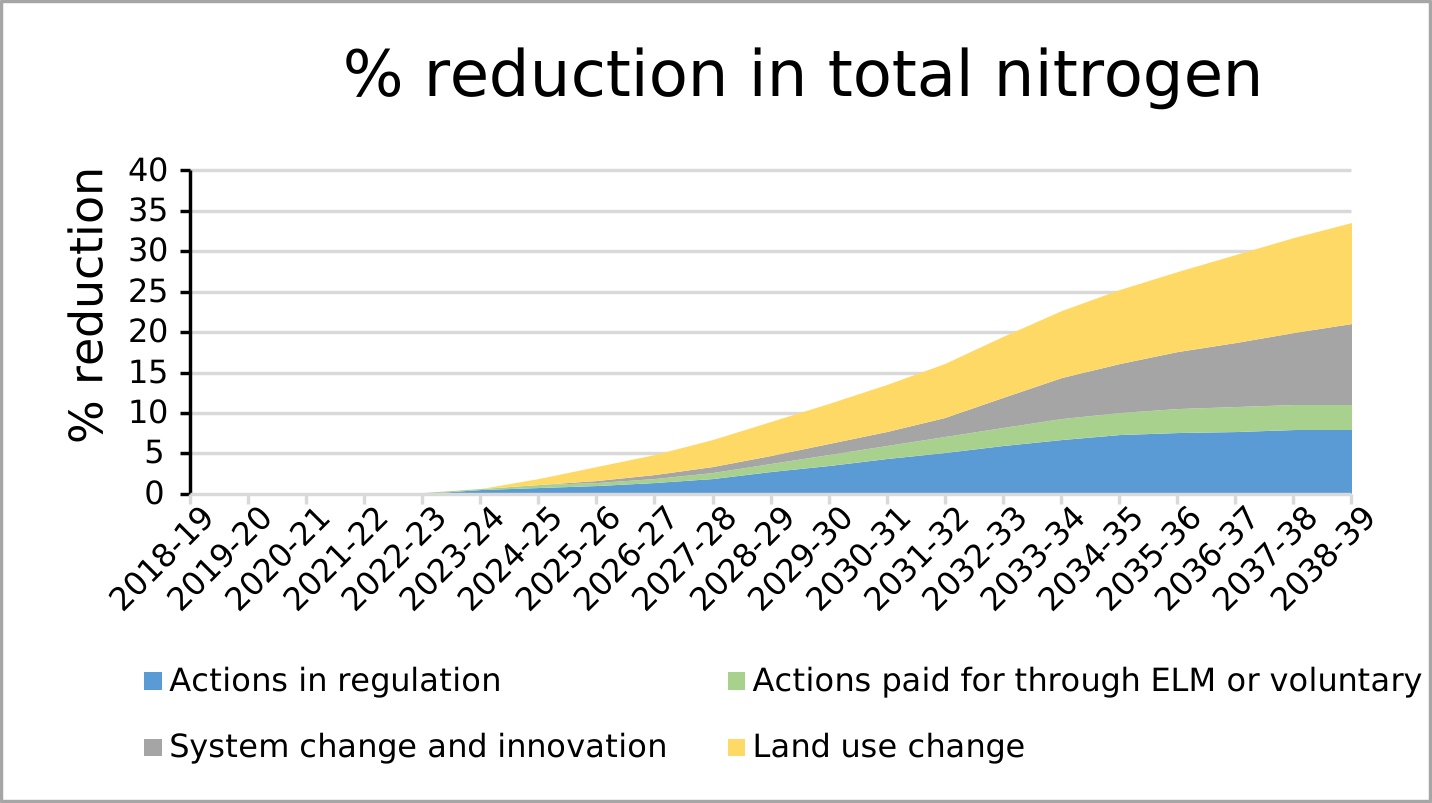
Figure 2. Predicted reductions of total nitrogen (TN) by mitigation pillar
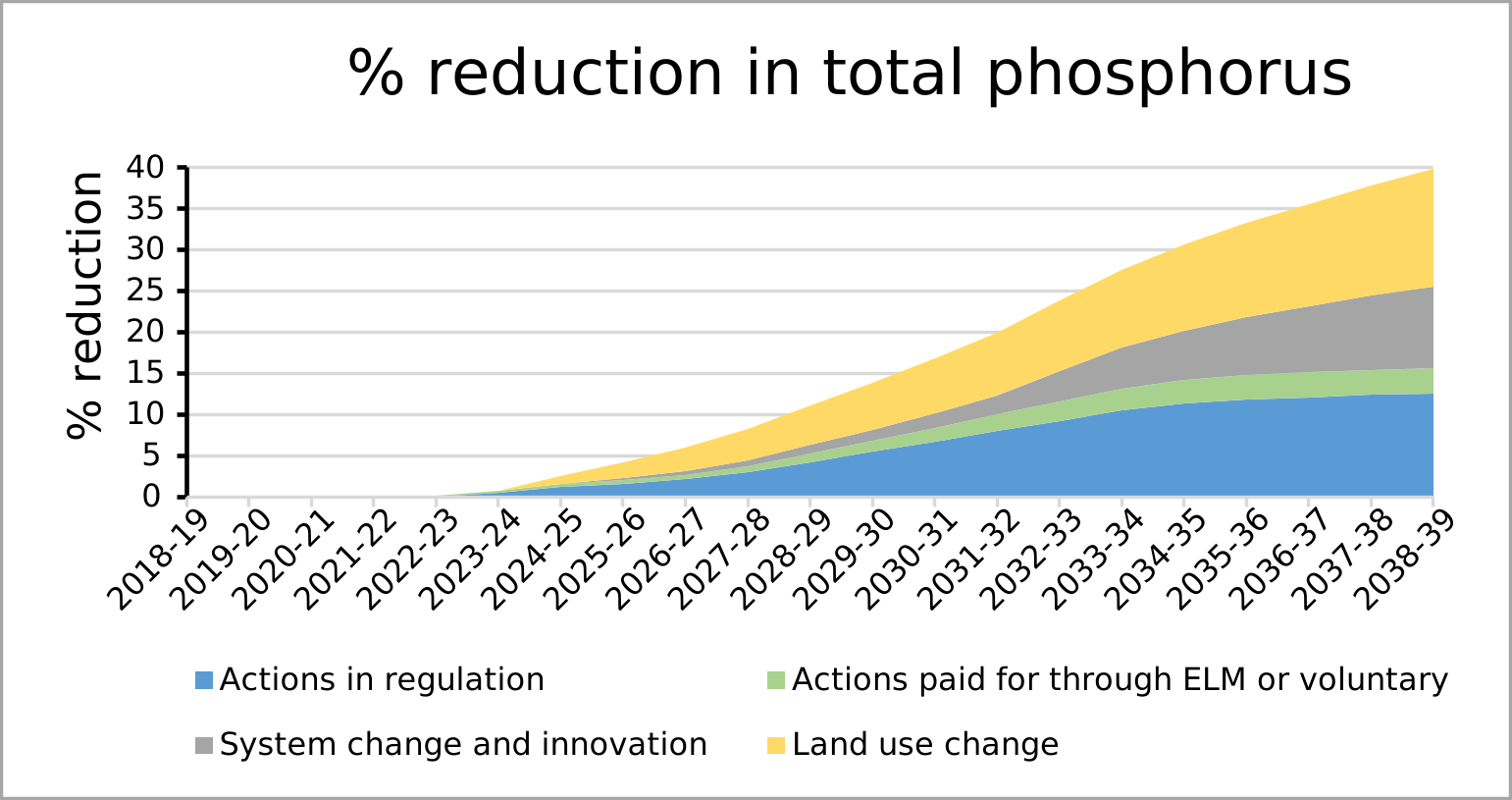
Figure 3. Predicted reductions of total phosphorus (TP) by mitigation pillar
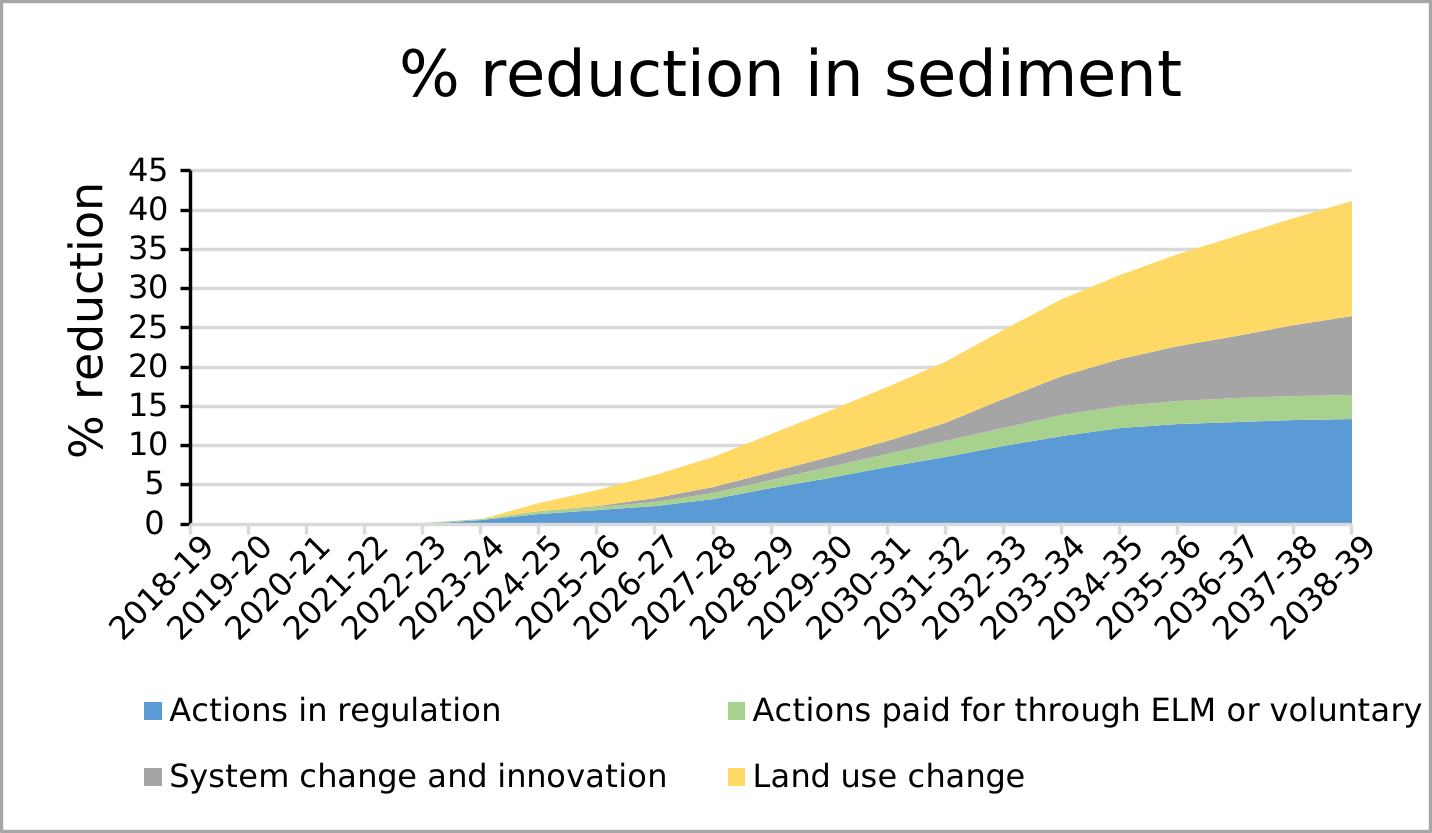
Figure 4. Predicted reductions in sediment load by mitigation pillar
The target trajectories outlined in Figures 2, 3 and 4 are derived from analysis that underpins the statutory target. Both the current and proposed interim targets assume that existing farming policies aimed at reducing water pollution will be implemented as planned, following the pathways and timelines described.
Farmers’ response to policies is assumed to follow an ‘S-shaped’ curve, with slow uptake in earlier years, accelerating as benefits are realised and then levelling out as a new improved status quo is reached. The pattern reflects previous participation with comparable schemes in Environmental Stewardship and Countryside Stewardship.
The target for catchments containing protected sites in unfavourable condition due to nutrient pollution is more ambitious than the national target. However, an accelerated pace of delivery is logical given the targeting of actions in these locations, such as more EA farm inspections and advice.
Monitoring and evaluation summary
Defra is working to establish a direct method of monitoring to measure progress against the statutory target. This includes work to:
-
create a modelling conversion tool for nitrate to total nitrogen, to enable current models to estimate total nitrogen losses from agricultural land to water, rather than nitrate. This is an important step to measuring interim and final 2038 water quality targets.
-
review existing farm emissions models, to identify the most suitable model, ensemble of models, or methods to measure interim and statutory target progress.
Until 2030, we will report progress using proxy and action-based indicators, for example soil nutrient balance, uptake of government funded agri-environment schemes with benefits to water quality, the number of ameliorative actions undertaken following Environment Agency farm regulatory inspections or Catchment Sensitive Farming advice visits. These proxies will be the main reporting method while a more comprehensive modelling method is developed.
Evaluation of intervention impacts on agricultural pollutant losses has also predominantly been conducted using modelling approaches. The basis of the modelling was done with FARMSCOPER, the leading policy tool for determining diffuse agricultural pollution management in England.
The EA’s National Agriculture Programme, funded through the Catchment Sensitive Farming partnership, has developed a network of sites across England since 2006 to monitor water quality from agricultural sources. It makes it the best-placed network to validate the modelled pollutant reductions.
The Natural Capital Ecosystem Assessment (NCEA) programme is assessing England’s land, freshwater, and coastal ecosystems to produce a baseline of our natural assets by 2028. NCEA measures the location, extent and condition of habitats and is informing the Monitoring and Evaluation of Environmental Land Management schemes. This national monitoring programme has developed Defra’s environmental monitoring capabilities, which can be used to measure environmental change at a national and regional level.
References
Dillon A and Wentworth J (2024). ‘Innovation and technology in agriculture and alternative foods’